
Civitas OSData intelligence for the public sector
Public intelligence. Global perspective. Connect evidence, priorities and foresight to help governments act with confidence, grounded in each territory's reality.
- Evidence
- Official sources, traceable findings and explicit data gaps.
- Priorities
- Resources, risks and public needs in one connected view.
- Foresight
- Explore possible responses before choosing a course of action.
- Accountability
- Human review, documented methods and an audit trail.
Civitas OS
The system, module by module.
Funding, public finances, procurement and territory in one connected view. Sources, rules and availability depend on each country's deployment.
Product in operation in Brazil. Screens show Brazilian data and interfaces; coverage and modules vary by market.
Funding
Track public funding from opportunity to execution, with deadlines, requirements and evidence.
/0.1
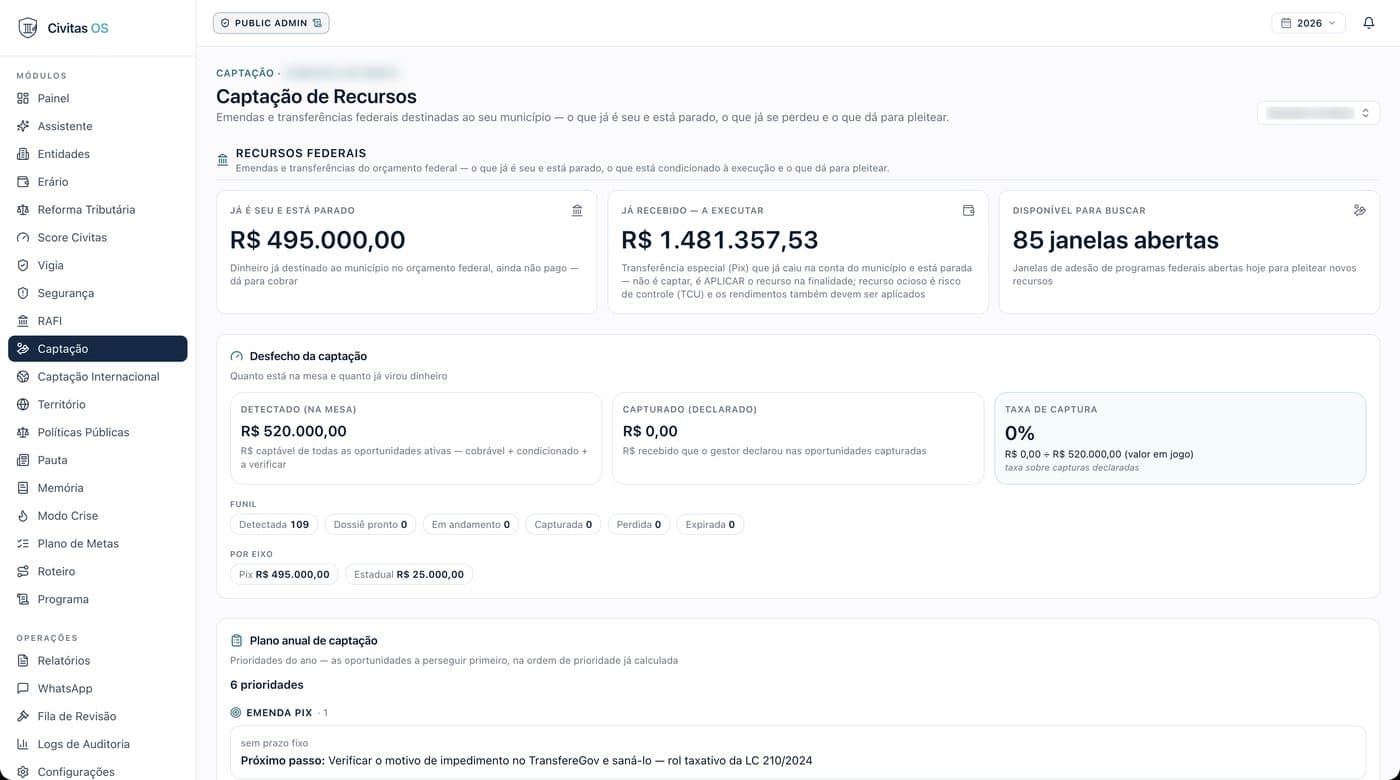
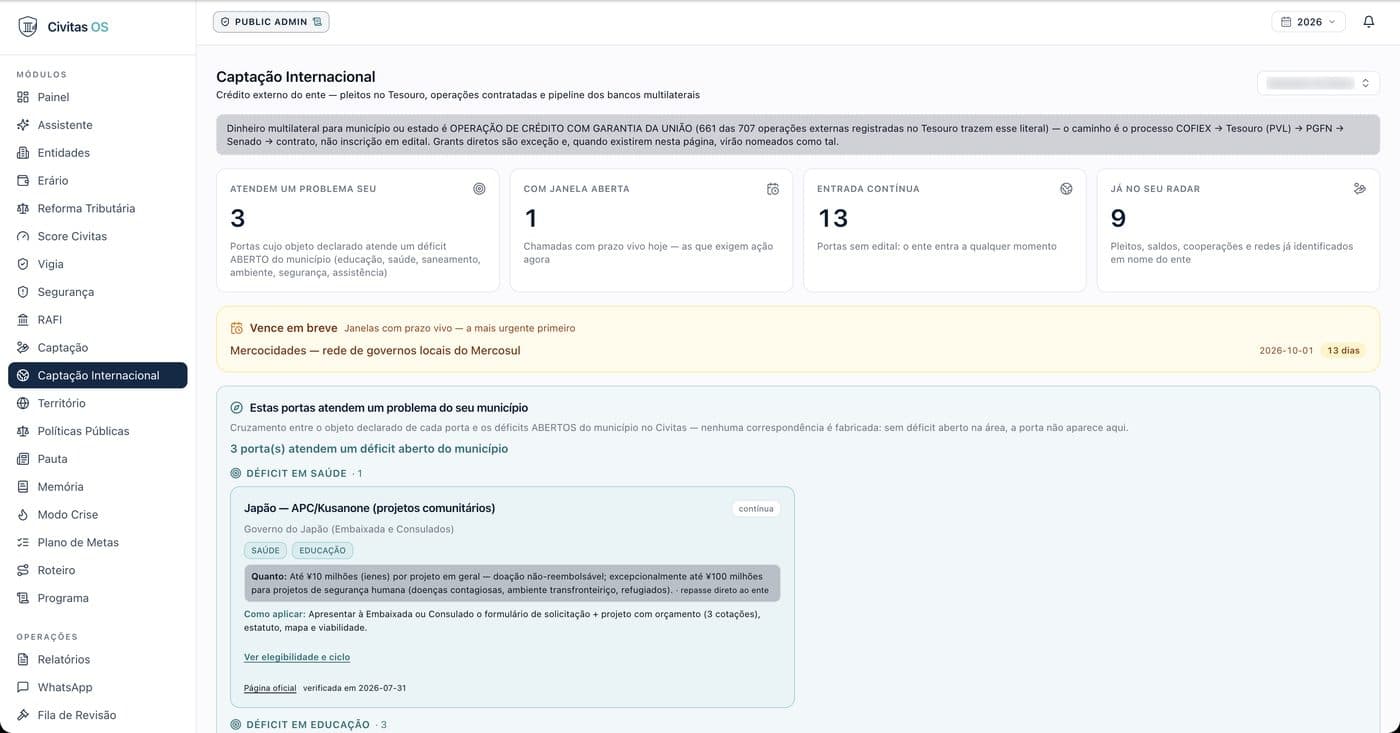
International Funding
Explore development finance, with eligibility, terms and a clear path to the next step.
/0.2
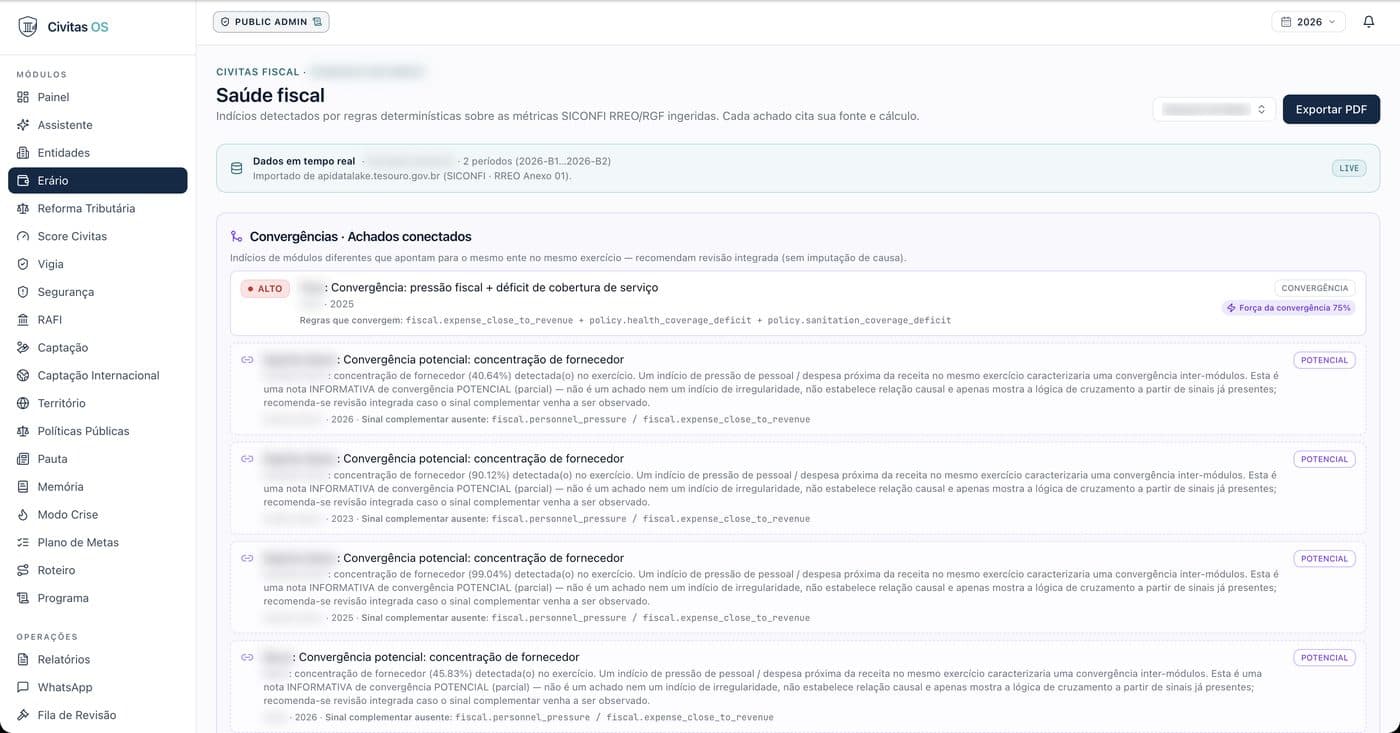
Treasury
Public finances in context: payroll, debt, results and cash, with sources and applicable rules.
/0.3
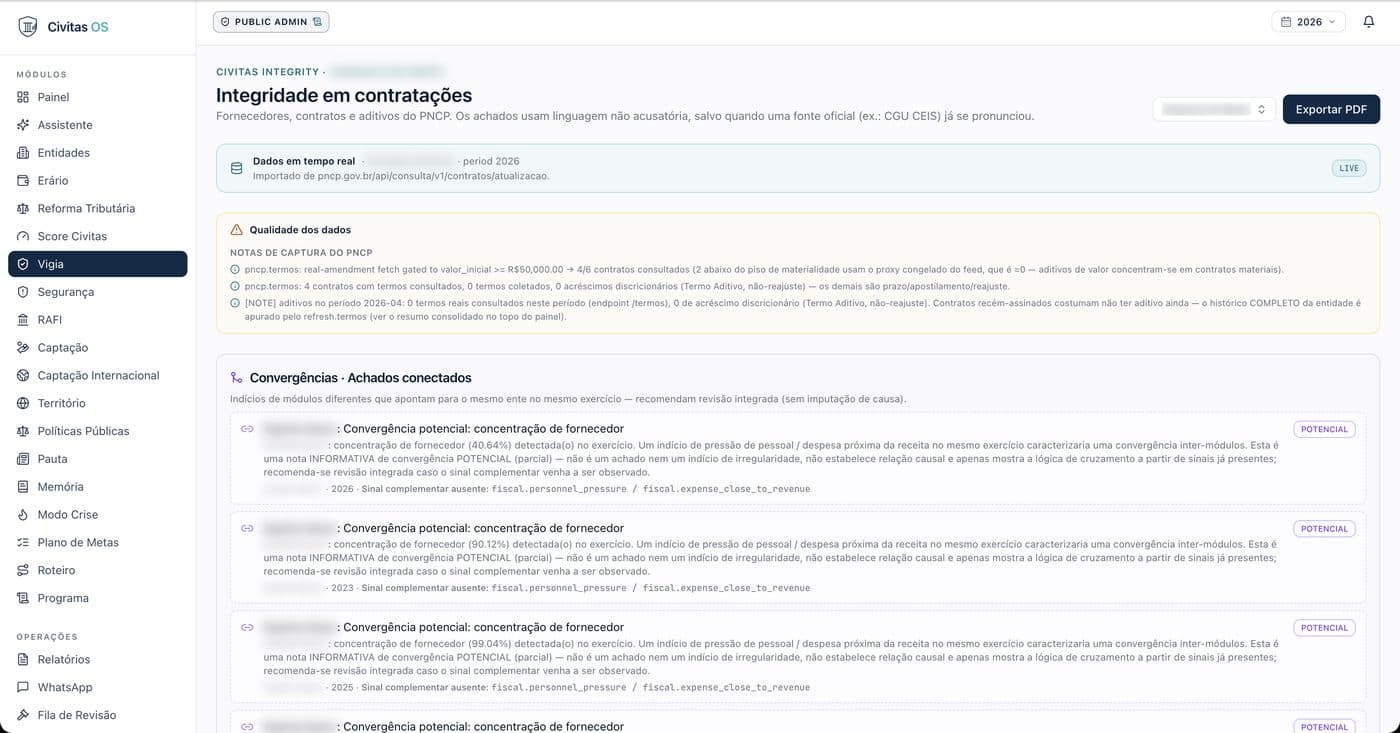
Watch
Procurement in the language of signals: supplier, amendment, sanction, PEP.
/0.4
Territory
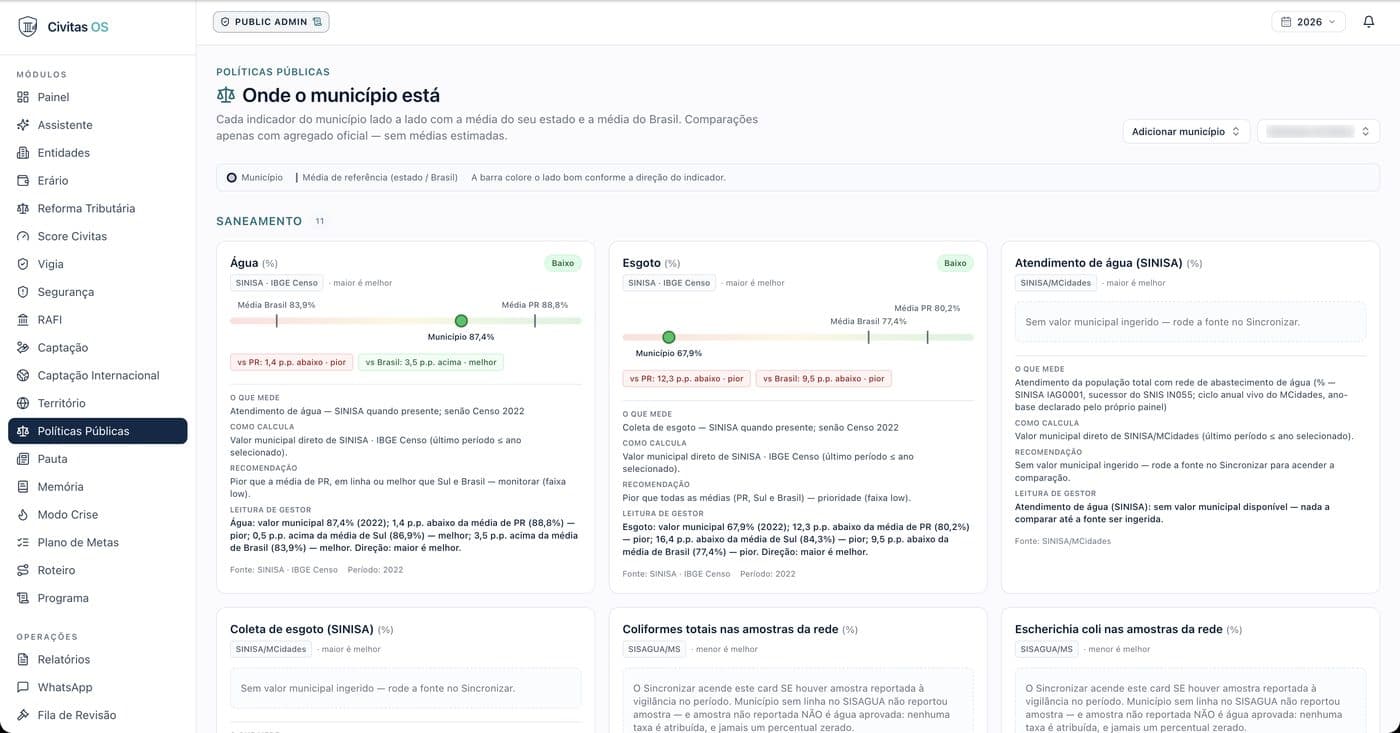
Connect indicators on the map and compare places using relevant geographic benchmarks.
/0.5
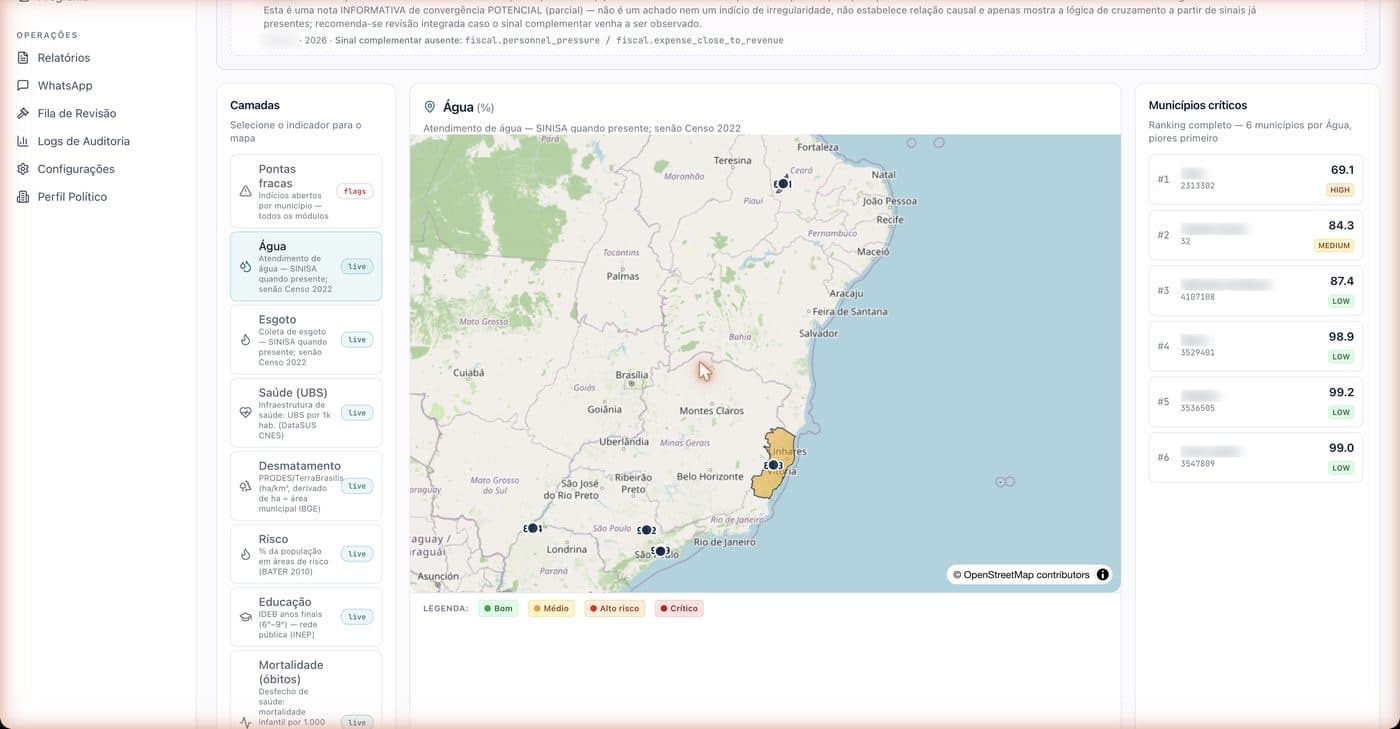
Public Policies
Health, education, sanitation, safety and risk, with evidence to guide public priorities.
/0.6
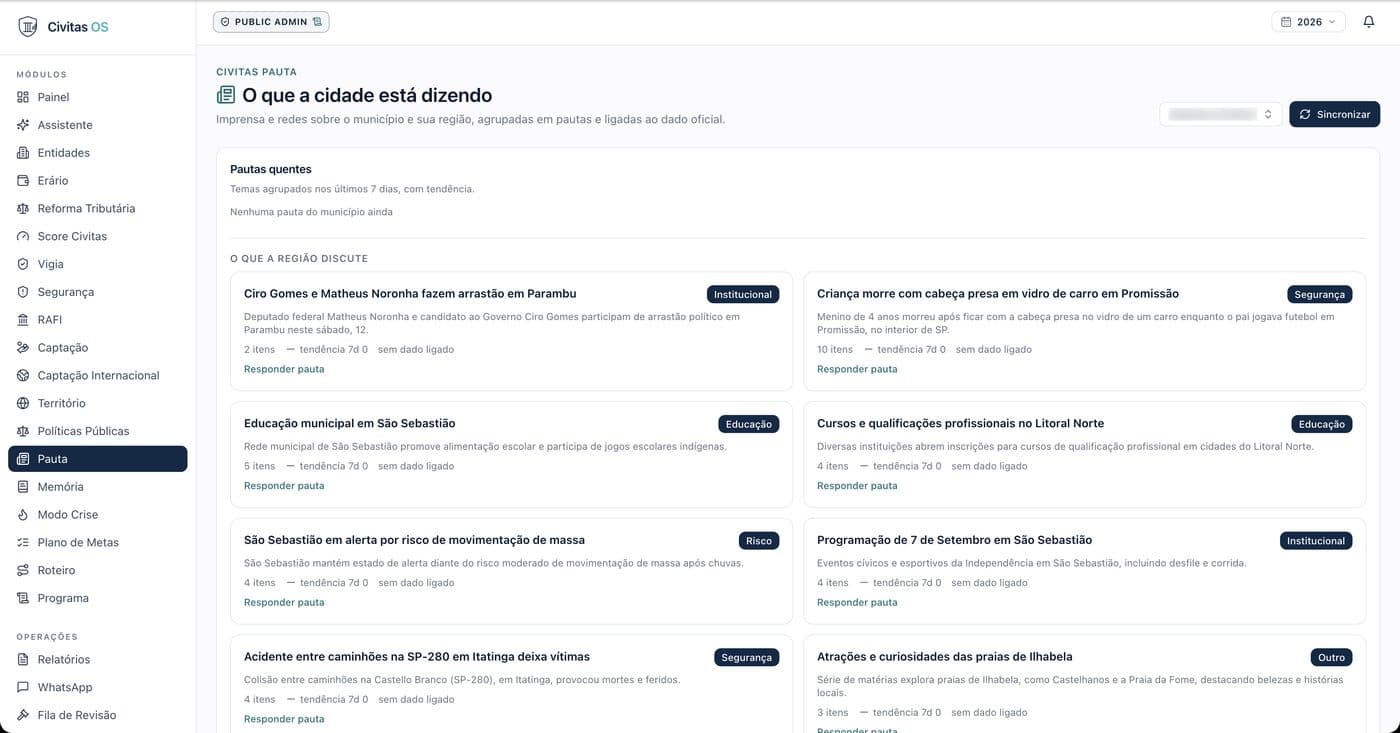
Agenda
What the city is saying, every day: news, networks and portals in one report.
/0.7
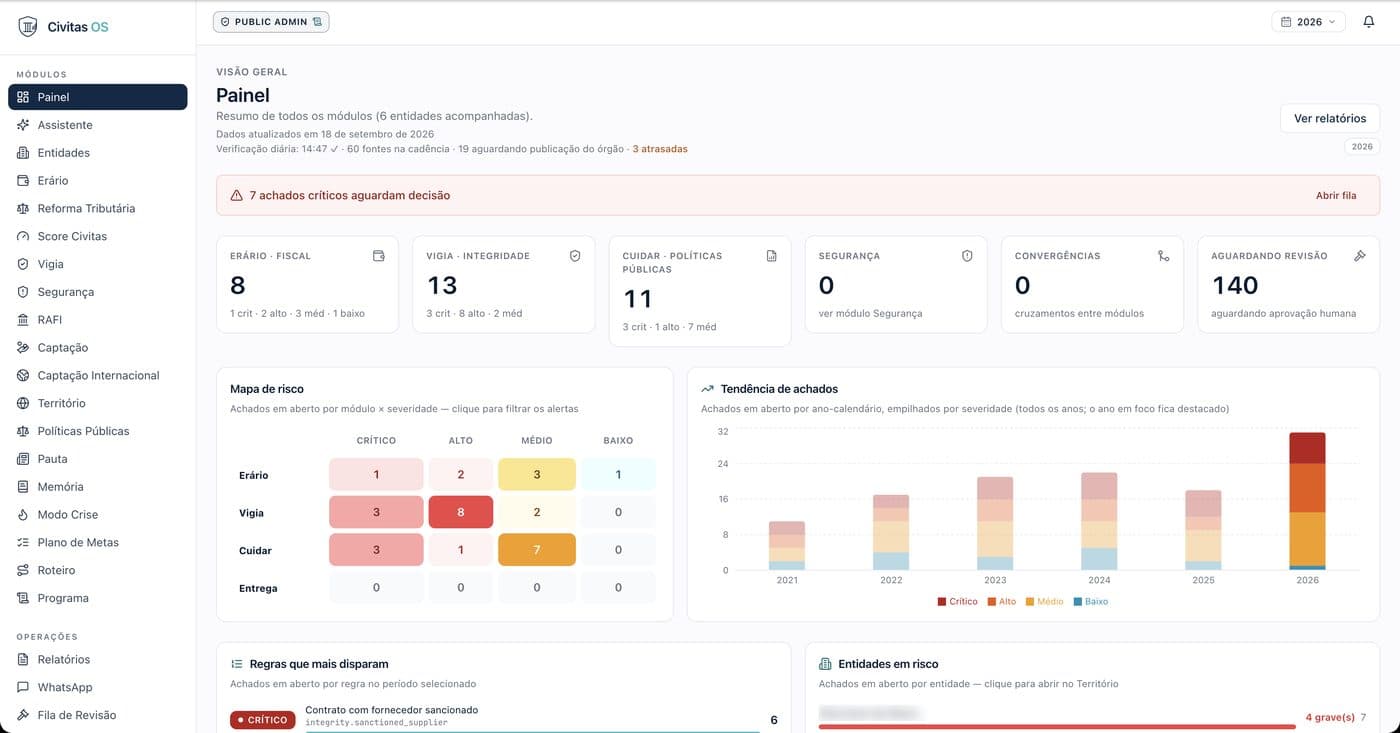
Dashboard
Every module in one crossed view: findings, trend and what awaits a decision.
/0.8
And more
- Crisis Mode: war room with checkpoints, real-time presence and the first statement
- Assistant: ask the system, with a source in every answer
- Entities: public institutions, their contracts, suppliers and programs
- Local context: country-specific modules and rules, according to the deployment
- Safety: public safety indicators from available official sources
- Revenue recovery: public receivables and opportunities for collection
- Goals Plan: promises and goals with evidence of delivery
- Memory: citable reports, with source and period
- Route: field visits with context for every place
- Program: programmatic intelligence in a separate database
- Review Queue: nothing is published without a person deciding
- Audit Logs: every AI verdict recorded, never erased
Civitas Score
Local context. A broader perspective.
Turn public evidence into a clear view of performance. Understand strengths, reveal gaps and identify priorities, with comparisons that respect each territory's context.
Request a demoDiscuss the sources and capabilities available for your territory.
Context before comparison
Sources, institutions and public responsibilities differ. Begin with the reality of the territory being assessed.
Comparable on clear terms
Read every comparison alongside its scope, period and methodology. Different definitions are not interchangeable.
Evidence behind the assessment
Trace findings to their sources and make missing data explicit. An absent publication is not a measured result.
Coverage and assessment methods depend on the sources available in each territory. This is not a worldwide ranking or a credit rating.
Every finding is born with source, method and reviewer.
The system points to signals and anomalies. It never asserts illegality: a person concludes, before anything is published.
- 01Official source
- 02Deterministic rule
- 03AI guardrail
- 04Human review
- 05Publication
01 / 05
Graph
An LLM derives the ontology from the seed document and builds the graph of entities and relations.
Civitas Simulation
Rehearse the future before deciding.
From a single document, a parallel world of synthetic agents measures how a population would react to a policy, message or event.
What it is for
- 01Test how a policy lands before the announcement.
- 02Compare versions of a message, segment by segment.
- 03Anticipate the reaction to an event or a crisis.
- 04Ask any persona the why behind each reaction.
Synthetic personas, aggregated data. No real voter is profiled.
End to end
- 01
A document comes in
A policy proposal, a message or the description of an event. The model derives the ontology and builds the graph of entities and relations.
- 02
A synthetic population is born
Synthetic personas use aggregated demographic context from the study. Data sources and assumptions are documented; personas do not represent real people.
- 03
A forecast report comes out
Context and methodology, identified segments, reaction dynamics, forecast and recommendations. Declared uncertainty and an audit trail.
The cycle with Civitas OS
- 01
The OS diagnoses the present
Official sources, signals with method and confidence.
- 02
Simulation rehearses the future
The population's reaction to each course of action.
- 03
The decision comes out with evidence
Grounded in what is and in what will probably be.
The result feeds the diagnosis back: a continuous cycle of evidence.
Personas and agents are synthetic and do not represent real people. Simulation does no individual targeting and no psychographic profiling of real voters: it measures reception in aggregate, auditably.
Trust is architecture.
- A
Guardrails on every AI call
Eight checks on the input and output of every agent: six block, two warn. Verdicts land in an audit log.
- B
Physical separation of uses
Governmental and programmatic use live in separate databases, with mutually exclusive roles and their own logs.
- C
Tenant isolation
Organization-level access controls and data isolation keep each institution's information separate.
- D
Official, aggregated data only
Privacy by design: public sources, aggregation, no individual profiling and human review on every sensitive flow.
Bring your public challenge to Civitas.
Tell us who you are and which product interests you. We reply within two business days with a demo in your context.
info@civitas-os.com